In the sweltering heat of Sri Lanka’s central plains, a massive, black rock mass rises 160 meters out of the greenery. From a distance, it looks like a sleeping giant, imposing and impenetrable. But climb the stone steps, push past the chattering macaque monkeys, and step beneath the drip-ledge of the granite overhang, and you will find yourself in a world of gold, serenity, and ancient artistry.
This is the Dambulla Cave Temple, also known as the Golden Temple of Dambulla.
While many travelers rush through Dambulla on their way to the more famous rock fortress of Sigiriya, those who pause here discover one of the most spiritually charged and historically significant sites in all of South Asia. As the largest and best-preserved cave temple complex in Sri Lanka, Dambulla is a UNESCO World Heritage site that offers a window into over two millennia of Buddhist culture.
Whether you are a history buff, a spiritual seeker, or a backpacker charting a course through the “Teardrop of India,” this guide will take you deep into the caves and explore everything else this vibrant town has to offer. The Heart of the Cultural Triangle Dambulla.
A History Carved in Stone: The Legend of King Valagamba
To truly appreciate Dambulla, you must understand the drama that birthed it. The story takes us back to the 1st Century BC.
King Valagamba (also known as Vattagamini Abhaya) had just ascended to the throne of the Anuradhapura Kingdom when South Indian invaders usurped his power. Fleeing for his life, the King sought refuge in the dense forests and caves of Dambulla. For 14 years, he lived in exile, meditating in these caves and protected by local Buddhist monks who provided him with food and shelter.
During those long years of hiding, Valagamba made a vow: if he ever regained his throne, he would transform these rough caves into magnificent temples as a gesture of gratitude to the monks.
In 89 BC, Valagamba returned to Anuradhapura, defeated the invaders, and reclaimed his crown. True to his word, he returned to Dambulla and began the process of carving the interior of the rock into shrine rooms. Over the next two thousand years, successive kings added to the complex, gilding statues, painting intricate murals, and expanding the shrines. What you see today is a collaborative masterpiece spanning twenty centuries of Sri Lankan history.
The Climb: Pilgrims, Monkeys, and Panoramas
The experience of Dambulla begins at the bottom of the rock. There are two entry points, but most visitors start near the Golden Temple (a modern addition) and hike up the western slope.
The climb is not as grueling as Sigiriya, but in the midday heat, the steps can be tiring. It takes about 20 to 30 minutes to reach the summit. As you ascend, the view opens up behind you. The flat plains of the dry zone stretch out to the horizon, dotted with reservoirs (tanks) and jungle. If the weather is clear, you can see the distinct silhouette of Sigiriya Rock Fortress rising from the jungle floor about 20 kilometers away—a spectacular photo opportunity.
The Monkey Warning:
You will not be alone on this climb. Dambulla is home to troops of Toque Macaques. While they are photogenic, they are also seasoned thieves. Keep your water bottles inside your bag, avoid eating snacks on the stairs, and hold onto your sunglasses. They have learned that tourists equal food, and they can be quite bold.
Inside the Caves: A Walkthrough
Once you reach the top terrace, you must remove your shoes and leave them at the counter (a small fee applies). The ground can be scorching hot if you visit at noon, so bring a pair of thick socks to protect your feet.
The complex consists of five main caves (shrines), each unique in its layout and contents.
Cave 1: Devaraja Lena (The Cave of the Divine King)
The first cave is relatively small, creating an intimate atmosphere. Dominated by a massive 14-meter rock-cut statue of the dying Buddha (Parinirvana), the space feels heavy with silence.
The Buddha is depicted in his final moments, passing into Nirvana. If you look closely at the feet, you will notice a subtle detail: the toes are slightly misaligned, and the red paint on the soles mimics the lotus flower. At the Buddha’s feet stands his favorite disciple, Ananda, weeping.
The name “Cave of the Divine King” comes from the belief that the god Vishnu participated in the creation of this cave. A small, somewhat weathered statue of Vishnu can be found here, highlighting the unique syncretism in Sri Lankan Buddhism, where Hindu deities are often venerated as protectors of the faith.
Cave 2: Maharaja Lena (The Cave of the Great Kings)
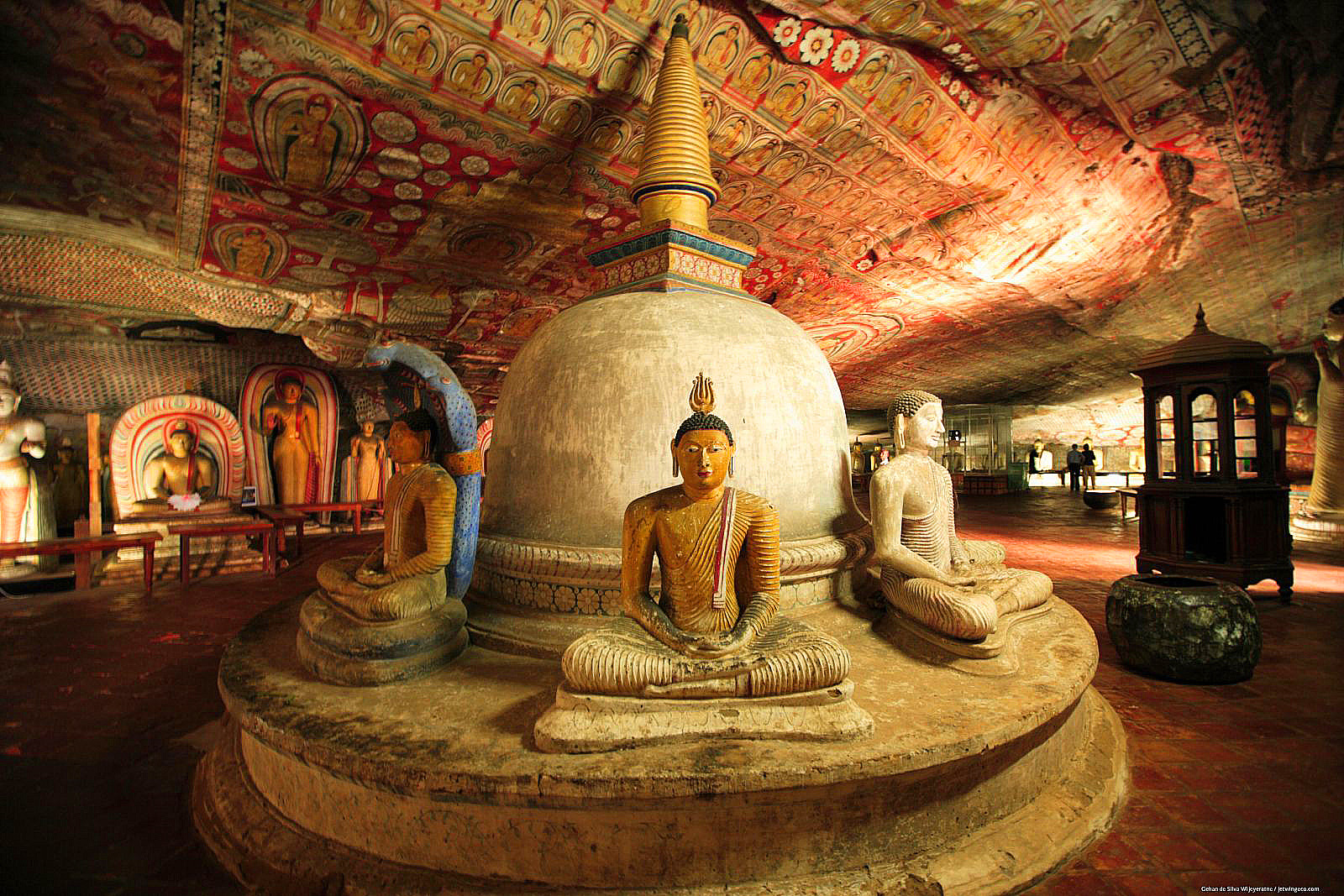
This is the showstopper. The Maharaja Lena is the largest and most impressive of the five caves. It is roughly 52 meters long and 23 meters deep, with a ceiling height that reaches 7 meters at its peak.
As you step inside, your eyes are immediately drawn upward. The ceiling is a canvas of intricate murals depicting the life of the Buddha and the history of the Sinhalese people. These are not just decorative; they are storytelling devices meant to educate the illiterate masses of ancient times. The rock surface is uneven, yet the artists masterfully painted geometric patterns and scenes that flow with the contours of the stone.
The cave contains over 50 statues of Buddha in standing, seated, and reclining postures. However, it is named for the statues of two kings: King Valagamba (the founder) and King Nissanka Malla (a 12th-century ruler who is said to have gilded 50 statues here).
The Miracle of the Water Pot:
On the right side of the cave, there is a vessel that collects water dripping from the ceiling. Even during severe droughts, this water source never dries up. It is considered sacred and is used only for ritual purposes. Interestingly, the water drips from a point in the ceiling where the rock slopes upward, defying gravity—a geological oddity that adds to the mystique of the cave.
Cave 3: Maha Alut Viharaya (The Great New Monastery)
Separated from the second cave by a masonry wall, this cave was converted from a storeroom into a temple in the 18th century by King Kirti Sri Rajasinha of the Kingdom of Kandy.
Because this cave was decorated much later than the first two, the artistic style is different. This is the Kandy Style—characterized by bright reds and yellows, floral motifs, and dragon arches (Makara Torana). The ceiling paintings here are particularly vibrant. A statue of the King stands near the entrance, looking toward the reclining Buddha.
Cave 4: Pachima Viharaya (The Western Temple)
This is the smallest of the caves. It was packed with small dagobas (stupas) that were broken into by thieves in search of jewelry belonging to the queens of the past. The central Buddha figure is seated under a Makara Torana (dragon arch), and the feeling here is more compact and meditative.
Cave 5: Devana Alut Viharaya (The Second New Temple)
The final cave is the newest, renovated in the early 20th century. It features a reclining Buddha and several standing Buddhas. While it lacks the ancient patina of the other caves, it demonstrates that Dambulla is a living site, constantly maintained and updated by the faithful.
The Golden Temple & The Museum
At the foot of the rock lies the “Golden Temple,” a modern edifice completed in 2000. It is impossible to miss, largely due to the colossal 30-meter-tall golden Buddha statue seated atop the building in the Dhammachakka Mudra (wheel-turning posture).
The architecture is a subject of debate; it is a flamboyant mix of concrete, neon colors, and kitsch that contrasts sharply with the ancient, organic beauty of the caves above. The entrance is formed by the gaping mouth of a golden dragon.
Inside this building is the Dambulla Museum. It is worth a quick visit if you want to see replicas of the cave paintings (allowing you to see details that are too high up or faded in the actual caves) and artifacts found in the area. However, the real treasure remains the ancient rock above.
Beyond the Caves: Other Things to Do in Dambulla
Many tourists treat Dambulla as a half-day trip, but if you linger, you’ll find other gems in the vicinity.
1. The Dambulla Dedicated Economic Centre
If you want to see the “real” Sri Lanka, head to the wholesale market. Dambulla is the geographical center of the country’s vegetable distribution. Every night and early morning, hundreds of trucks arrive here laden with produce.
It is a chaotic, colorful, high-energy environment. You’ll see mountains of pumpkins, sacks of carrots, and bananas by the ton. It offers a fascinating look at the agricultural backbone of the island. (Best visited in the evening around 7 PM or early morning).
2. Popham’s Arboretum
For nature lovers, this is a hidden sanctuary. Established by British planter Sam Popham in the 1960s, this is Sri Lanka’s only dry-zone arboretum.
Popham’s method was unique: rather than planting trees, he simply cleared the scrub and allowed the indigenous tree seedlings to grow, restoring the forest to its natural state. It is a peaceful place for a walk, but the real magic happens at night.
The Night Safari:
Popham’s is one of the best places in the world to spot the Grey Slender Loris, a shy, nocturnal primate with large, soulful eyes. Guided night walks here are magical, often revealing mouse deer, civets, and owls.
3. Jathika Namal Uyana (Rose Quartz Mountain)
Located about 7 miles from Dambulla, this is the largest ironwood forest in Sri Lanka and home to a unique geological feature: a mountain range made entirely of pink rose quartz.
The hike to the top is rewarding. The quartz rocks, weathered by time, have a subtle pink hue that glows under the sun. According to history, the rose quartz used to decorate the Taj Mahal in India was mined from this very range.
4. Ibbankatuwa Megalithic Tombs
Just a few kilometers from the cave temple lies a site that predates Buddhism in Sri Lanka. The Ibbankatuwa burial site dates back to 700–400 BC.
It consists of stone slab tombs (cist burials) containing clay pots, beads, and copper necklaces. It’s a small site, but it provides crucial context: people lived, loved, and died in Dambulla long before King Valagamba sought refuge in the caves.
Practical Guide: Planning Your Visit
Best Time to Visit
- Time of Day: The best times are early morning (7:00 AM) or late afternoon (4:00 PM). This avoids the brutal midday sun and the large tour bus crowds. Sunset from the top of the rock is particularly beautiful.
- Season: Sri Lanka has two monsoon seasons. Dambulla is in the “Dry Zone,” so it is generally visitable year-round. However, January to March is the driest and most pleasant period.
Dress Code: Strictly Enforced!
This is the most common pitfall for tourists. Dambulla is a sacred Buddhist site, and the dress code is strictly enforced at the ticket checkpoint.
- Shoulders: Must be covered (no tank tops, no spaghetti straps).
- Knees: Must be covered (no shorts, no short skirts).
- Accessories: Hats and caps must be removed inside the temple complex.
Pro Tip: Carry a sarong or a large scarf in your backpack. If you are wearing shorts, you can simply wrap the sarong around your waist before entering.
Tickets and Entry
- Tickets must be purchased at the bottom of the hill (usually at the counter near the Golden Temple statue) before you climb up. There is no ticket counter at the top. If you climb all the way up without a ticket, you will have to walk all the way back down.
- Price: As of late 2023/2024, the price is roughly $10 USD (check current rates as they fluctuate with the LKR exchange rate).
Staying in Dambulla vs. Sigiriya
This is a common debate. Should you stay in Dambulla or nearby Sigiriya?
- Stay in Sigiriya if you want a more “jungle” vibe, with guesthouses tucked away in the trees and views of the Lion Rock.
- Stay in Dambulla if you want better access to transport (buses to Kandy, Jaffna, and Trincomalee all pass through here), more dining options, and cheaper accommodation.
- The Luxury Option: Dambulla is home to Heritance Kandalama, designed by the legendary Geoffrey Bawa. The hotel is built into the rock face and covered in vegetation, blending seamlessly with nature. Even if you don’t stay there, go for lunch or high tea to admire the architecture.
Sample One-Day Itinerary: The Cultural Triangle Loop
If you are based in Dambulla or Sigiriya, here is how to structure a perfect day:
- 06:30 AM: Climb Sigiriya Rock Fortress (Lion Rock). Go early to beat the heat and the crowds.
- 10:30 AM: Return to hotel for breakfast and a shower.
- 12:30 PM: Lunch at a local “Rice and Curry” buffet. Look for places serving lake fish or jackfruit curry.
- 02:30 PM: Visit the Ibbankatuwa Megalithic Tombs (quick 30-minute stop).
- 04:00 PM: Begin the climb to Dambulla Cave Temple.
- 05:30 PM: Watch the sunset from the Dambulla rock, looking out over the jungle toward Sigiriya.
- 07:30 PM: Dinner and bed (or a night walk at Popham’s Arboretum).
Cultural Etiquette and Respect
Visiting Dambulla is a spiritual experience for locals. You will see families dressed in white, carrying lotus flowers to offer to the Buddha.
- Photography: You are allowed to take photos of the statues, but never pose with your back to the Buddha. This is considered extremely disrespectful. When taking a photo, stand to the side or face the Buddha. Selfies that turn your back on the statue can get you scolded by guards or locals.
- Silence: Keep your voice down inside the caves. The acoustics are such that voices carry, and many people are there to meditate.
Why Dambulla Matters
In a world where travel is often about the “Insta-perfect” moment, Dambulla offers something deeper. It offers continuity.
When you stand in the Maharaja Lena, looking at paintings that have been touched up by kings from the 1st century, the 12th century, and the 18th century, you realize you are part of a long chain of humanity that has stood in this exact spot, marveling at the same beauty.
It is a place where art, history, and geology collide. The juxtaposition of the dark, cool caves against the harsh, bright sun of the Sri Lankan dry zone creates a sensory experience that stays with you long after you leave.
So, when you plan your Sri Lankan adventure, do not just drive past Dambulla on your way to the beach or the tea plantations. Stop. Climb the rock. Let the monkeys chatter, let the heat rise, and step into the cool shadows of history. The Golden Temple awaits.